Cognitive Behavioral Therapy for Anxiety: What To Expect
Your mind races with worst-case scenarios. Your chest tightens before a meeting, a phone call, or sometimes for no clear reason at all. Anxiety can feel like a constant companion that shows up uninvited and refuses to leave. The good news? Cognitive behavioral therapy for anxiety is one of the most researched and effective treatments available, and it gives you practical tools to change how your brain responds to fear.
Unlike approaches that focus only on talking through your past, CBT targets the specific thought patterns and behaviors that keep anxiety stuck in a loop. This article walks you through exactly how the process works, from identifying your triggers to learning concrete techniques you can practice on your own. You’ll understand what a typical session looks like, which exercises therapists commonly use, and how long treatment usually takes to produce real change.
At New Perspective Counseling, we integrate CBT with other evidence-based approaches to create treatment plans that fit each person’s unique situation. Whether you’re considering therapy for the first time or exploring your options after previous attempts, understanding what to expect can make starting feel less intimidating. Here’s a clear look at how CBT works and why it’s helped so many people reclaim their lives from anxiety.
Why CBT works for anxiety
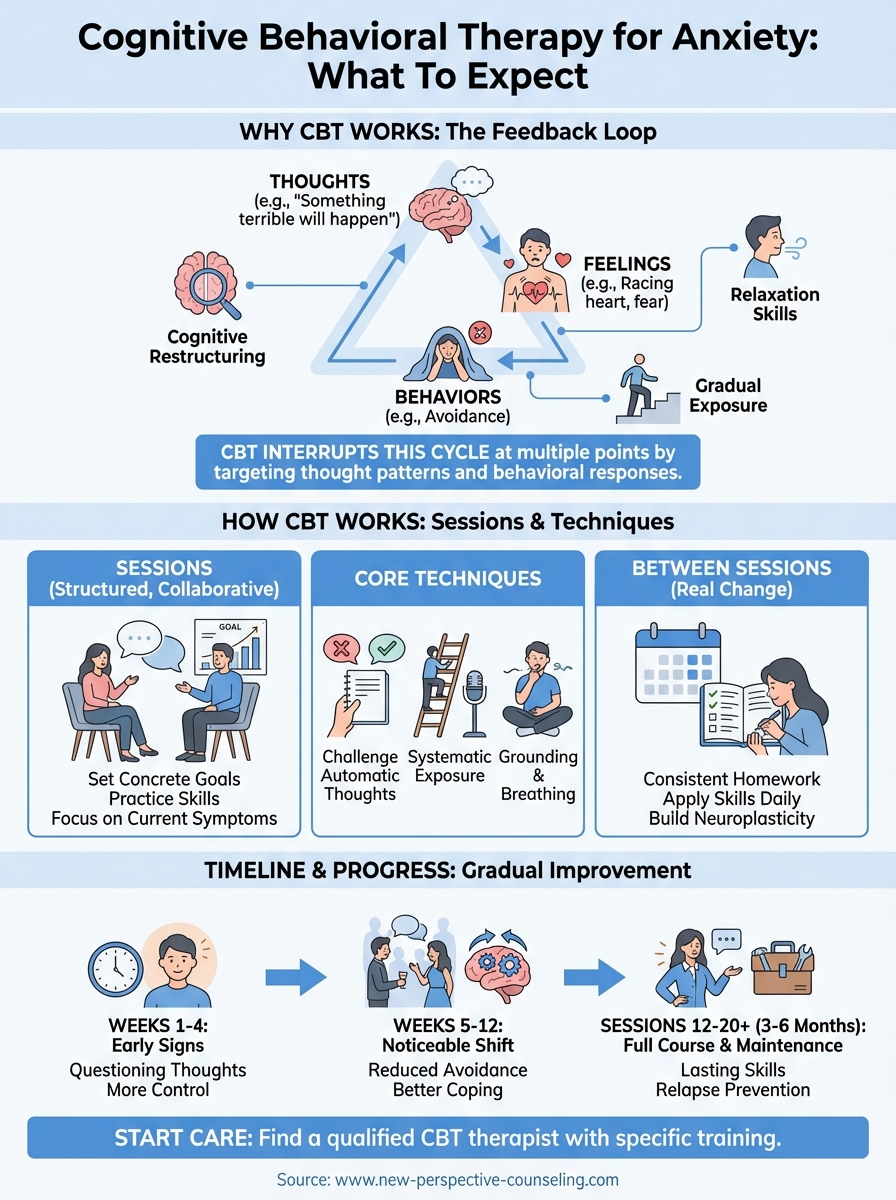
Your anxiety doesn’t exist in a vacuum. It lives in the constant feedback loop between what you think, how you feel, and what you do. Cognitive behavioral therapy for anxiety works because it interrupts this cycle at multiple points, giving you control over responses that have felt automatic for years. Instead of treating anxiety as something that happens to you, CBT teaches you to recognize your role in maintaining it and, more importantly, your power to change it.
The thought-feeling-behavior connection
Your thoughts shape your emotional reactions, which then drive your behaviors, and those behaviors reinforce the original thoughts. When you think “I’m going to embarrass myself at this event,” your body responds with physical anxiety symptoms like a racing heart or sweating. You then avoid the event, which temporarily reduces your discomfort but strengthens your brain’s belief that the situation was genuinely dangerous. This pattern repeats and intensifies each time you encounter similar triggers.
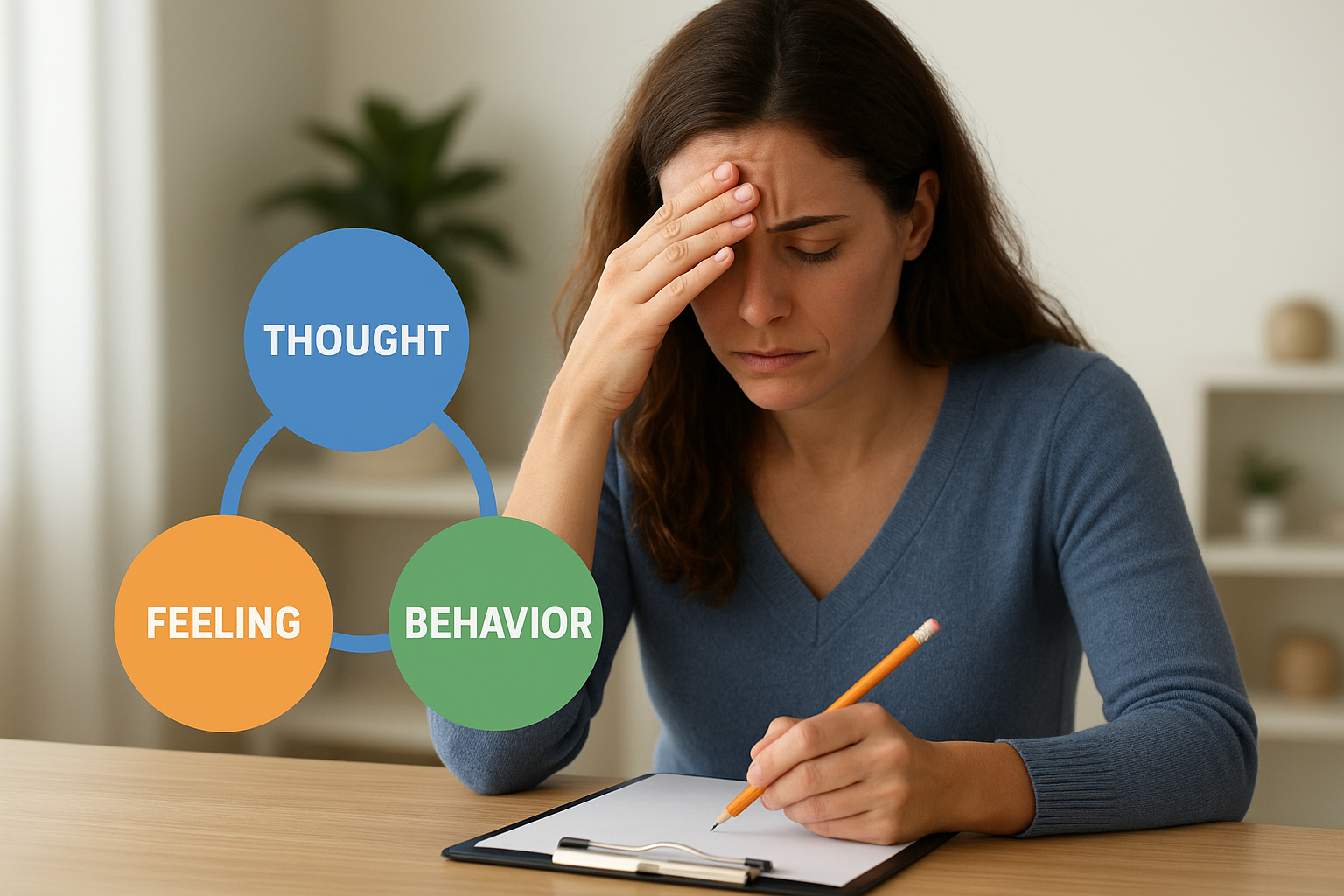
CBT targets all three parts of this triangle simultaneously. Therapists help you identify the specific thoughts that spark anxiety, challenge whether those thoughts are accurate or helpful, and gradually change the behaviors that keep the cycle alive. The approach doesn’t ask you to simply “think positive” or ignore your fears. Instead, you learn to examine evidence objectively and test your predictions against reality.
“The physical sensations you experience during anxiety are not dangerous, even though your mind interprets them as threats that require immediate escape.”
Why exposure reduces fear over time
Your brain learns through experience, and anxiety thrives when you avoid the things that scare you. Each time you sidestep a feared situation, your mind records that as confirmation of danger. CBT reverses this pattern through carefully planned exposure, where you face anxiety triggers in a controlled, gradual way while using new coping skills.
Repeated exposure teaches your nervous system that the feared outcome rarely happens, and even when discomfort occurs, you can tolerate it without catastrophe. Your brain literally rewires itself through this process, a phenomenon called neuroplasticity. The anxiety response weakens because you’re providing your mind with new data that contradicts old fear-based predictions. This isn’t about forcing yourself into overwhelming situations. Effective CBT builds exposure systematically, starting with less intense triggers and progressing as you gain confidence.
The research backing CBT’s effectiveness
Hundreds of studies confirm that CBT produces measurable changes in anxiety symptoms, often in just 12 to 16 sessions. Research shows that between 60% and 80% of people who complete CBT experience significant improvement, with many maintaining those gains long after therapy ends. Brain imaging studies have even demonstrated that successful CBT treatment changes activity patterns in areas of the brain responsible for fear processing and emotional regulation.
What makes these results particularly meaningful is that CBT teaches skills you keep using after therapy concludes. Unlike medication, which stops working when you discontinue it, the techniques you learn become permanent tools in your mental health toolkit. Studies tracking people years after treatment show that those who completed CBT are less likely to relapse compared to other interventions. The approach works across different types of anxiety, from generalized anxiety and panic disorder to social anxiety and specific phobias, making it one of the most versatile treatments available.
How CBT for anxiety usually works in sessions
Cognitive behavioral therapy for anxiety follows a structured, collaborative process where you and your therapist work together as partners. Each session builds on the previous one, creating a clear path from understanding your specific anxiety patterns to actively changing them. You won’t spend months talking about your childhood before addressing current symptoms. Instead, therapy focuses on practical skills you can apply immediately to reduce anxiety in your daily life.
What happens in your first session
Your therapist starts by asking detailed questions about when your anxiety shows up, what thoughts run through your mind during those moments, and how you typically respond. This isn’t a passive interview. You actively identify specific situations that trigger anxiety, rate how intense your distress feels, and describe the physical sensations you experience. Your therapist explains how CBT works and sets realistic expectations about the process, including how many sessions you might need and what you’ll practice between appointments.
Together, you establish concrete goals that go beyond “feel less anxious.” You might aim to attend social events without excessive preparation, sleep through the night without checking behaviors, or make phone calls without rehearsing every word. These specific targets give both of you a way to measure progress as treatment continues.
The structure of ongoing sessions
Most sessions follow a predictable format that helps you stay focused. You begin by reviewing what happened since your last appointment, discussing homework exercises and any challenges you encountered. Your therapist then introduces or practices a new technique, which might involve identifying thought distortions, learning relaxation strategies, or planning an exposure activity. The final portion focuses on assigning specific homework that applies what you learned.
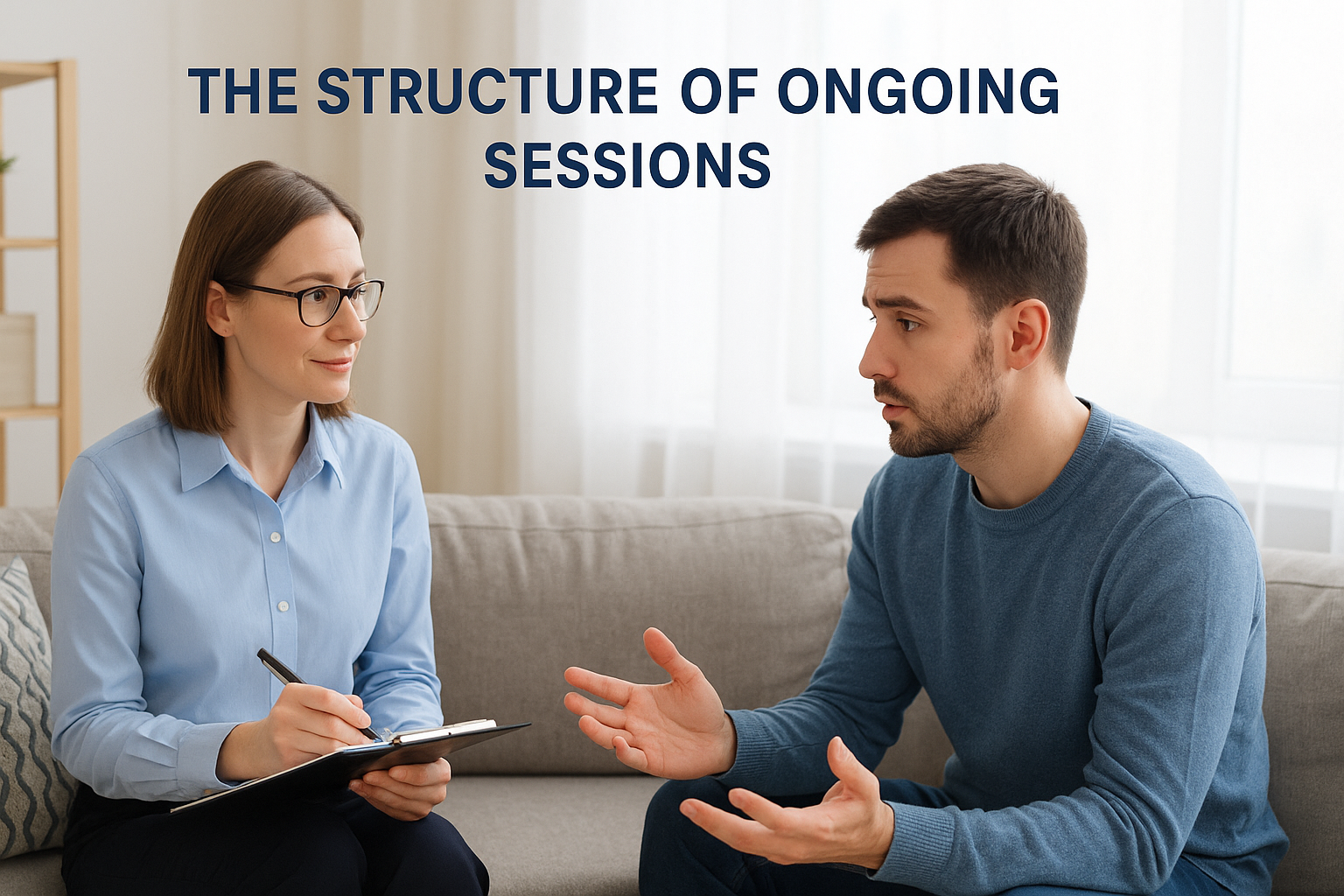
“Sessions typically last 45 to 60 minutes, and you’ll notice the most progress when you actively participate rather than expecting your therapist to simply give you answers.”
Homework between sessions
Real change happens in the time between appointments, not during them. Your therapist assigns exercises tailored to your specific anxiety patterns, such as tracking your thoughts in particular situations, practicing breathing techniques, or gradually confronting a feared activity. You might keep a thought record where you write down anxious thoughts and challenge them using questions your therapist teaches you. This consistent practice outside sessions reinforces new patterns and accelerates improvement.
The core CBT techniques for anxiety
Cognitive behavioral therapy for anxiety relies on specific, teachable methods that target the mechanisms keeping your anxiety active. Your therapist selects techniques based on your particular symptoms, triggers, and goals, combining them into a personalized treatment plan. These core approaches work together to address both the mental patterns and behavioral responses that maintain your distress.
Cognitive restructuring
You learn to catch automatic thoughts that flash through your mind during anxious moments, thoughts like “everyone will judge me” or “something terrible will happen.” Your therapist teaches you to write these down and examine them like a detective looking for evidence. You ask questions such as “What proof supports this thought?” and “What would I tell a friend thinking this way?” This process reveals how your mind jumps to conclusions, overgeneralizes from single events, or catastrophizes outcomes.
Rather than simply replacing negative thoughts with positive ones, you develop balanced, realistic perspectives based on actual evidence. If you think “I’ll definitely fail this presentation,” you might reframe it to “I’ve prepared thoroughly, and even if I stumble, most people won’t notice or care.” The goal is accuracy, not optimism. Your anxiety decreases when your thinking matches reality instead of worst-case predictions.
Behavioral activation and gradual exposure
Avoidance keeps anxiety alive, so your therapist guides you through systematic exposure to feared situations. You create a hierarchy that ranks anxiety triggers from least to most distressing, then work through them progressively. Someone with social anxiety might start by making eye contact with strangers, then progress to small talk, then attending gatherings. Each successful experience teaches your brain that the feared outcome rarely occurs.
“Exposure isn’t about eliminating anxiety before you act; it’s about acting despite anxiety and discovering you can tolerate the discomfort.”
Relaxation and grounding skills
Your body’s physical anxiety response can amplify worried thoughts, creating a feedback loop. Therapists teach specific techniques to interrupt this physiological arousal, including diaphragmatic breathing, progressive muscle relaxation, and grounding exercises that anchor you in the present moment. You practice slowing your breath to activate your parasympathetic nervous system, the calming mechanism that counters fight-or-flight activation. These skills don’t eliminate anxiety permanently, but they give you tools to manage intensity when symptoms spike, making other CBT techniques easier to apply.
Practical CBT exercises you can try today
You don’t need to wait for your first therapy session to start using cognitive behavioral therapy for anxiety techniques. Several core exercises translate directly into self-guided practice that you can implement immediately. These methods work best when you apply them consistently rather than only during crisis moments, building skills that become automatic over time. Start with one technique and practice it daily before adding others, giving yourself time to notice patterns and improvements.
Thought record practice
Grab a notebook and divide each page into three columns labeled “Situation,” “Automatic Thought,” and “Balanced Thought.” When you notice anxiety rising, write down what triggered it in the first column. In the second column, record the exact thought that went through your mind, even if it seems irrational. Your third column is where you challenge that thought by asking “What evidence supports this?” and “What would be a more accurate way to view this?” Someone anxious about a text not being answered might write “They’re ignoring me because I said something wrong” as the automatic thought, then counter with “They’re probably busy, and I have no evidence they’re upset.”
“The act of writing down your thoughts creates distance from them, helping you observe your mental patterns rather than getting swept away by them.”
The 5-4-3-2-1 grounding technique
This sensory exercise interrupts anxiety spirals by anchoring you in the present moment rather than letting your mind race toward imagined futures. Look around and identify five things you can see, then four things you can physically touch, three things you can hear, two things you can smell, and one thing you can taste. Move slowly through each sense, describing details like textures or colors. Your brain can’t simultaneously engage in abstract worry and concrete observation, so this practice calms your nervous system while giving you something to focus on besides anxious thoughts.

Behavioral experiments
Test your anxious predictions directly rather than accepting them as facts. If you believe asking a question in a meeting will result in harsh judgment, plan to ask one question and observe what actually happens. Write down your specific prediction beforehand, including how intense you expect your anxiety to feel and how others will respond. Afterward, record the actual outcome. Most experiments reveal that your worst-case scenarios rarely materialize, and even when discomfort occurs, you handle it better than expected. This evidence-gathering process weakens anxiety’s grip by showing your mind that its predictions are unreliable.
What progress looks like and how long it takes
Progress in cognitive behavioral therapy for anxiety doesn’t follow a straight upward line. You’ll experience good weeks and challenging weeks, with improvements accumulating gradually rather than arriving in a sudden breakthrough. Most people notice their first meaningful changes within four to six sessions, though the full treatment typically spans 12 to 20 sessions depending on the severity of your symptoms and how consistently you practice between appointments. Understanding what to expect at different stages helps you recognize progress when it happens and maintain motivation during plateaus.
Early signs of improvement
Your initial gains might feel subtle rather than dramatic. You catch yourself questioning anxious thoughts instead of accepting them automatically, or you notice your body’s tension building earlier than before. These small shifts represent fundamental changes in how you relate to anxiety, even when the intensity of your symptoms hasn’t decreased much yet. Some people sleep better within the first few weeks, while others find they can stay in uncomfortable situations slightly longer before needing to escape. The key indicator is that you start feeling more in control rather than completely at the mercy of your anxiety.
“Progress means learning to tolerate discomfort without immediately reacting, not eliminating all anxious feelings from your life.”
Timeline expectations for full treatment
Most people complete cognitive behavioral therapy for anxiety within three to six months when attending weekly sessions, though your specific timeline depends on factors like symptom severity, the number of anxiety triggers you’re addressing, and your commitment to homework exercises. Research shows that the majority of improvement happens in the first eight to twelve sessions, with remaining sessions dedicated to consolidating skills and preventing relapse. You’ll likely notice changes in this order: better awareness of your thought patterns, improved ability to challenge distorted thinking, reduced avoidance behaviors, and finally, decreased intensity and frequency of physical anxiety symptoms.
Measuring your success
Track specific behaviors rather than waiting to feel completely calm. Count how many times you engage with a feared situation instead of avoiding it, or note how quickly you can interrupt an anxiety spiral using your new techniques. Your therapist might use standardized questionnaires at regular intervals to quantify changes in your symptoms, giving you objective data about your progress. Recovery doesn’t mean never feeling anxious again. It means anxiety no longer dictates your choices, you can manage symptoms when they appear, and the interference in your daily life has decreased substantially enough that you can pursue the activities and relationships that matter to you.
Common questions and myths about CBT for anxiety
Several misconceptions about cognitive behavioral therapy for anxiety prevent people from trying this effective treatment. You might worry that therapy requires you to relive traumatic experiences or that your anxiety is too severe to respond to this approach. Understanding what CBT actually involves, versus what popular culture suggests, helps you make an informed decision about whether this treatment fits your needs. These clarifications address the most frequent concerns therapists hear from people considering CBT for the first time.
Does CBT force you to face your worst fears immediately?
Your therapist never throws you into overwhelming situations without preparation. Exposure happens gradually and systematically, starting with triggers that cause mild discomfort and progressing only when you feel ready. You control the pace of treatment, and your therapist works with you to design exposure exercises that feel challenging but manageable. Someone with a fear of public speaking might begin by speaking in front of a mirror, then to their therapist, then to a small trusted group before addressing larger audiences. This measured approach builds confidence while teaching your nervous system that feared outcomes rarely materialize.
“Effective exposure therapy respects your limits while gently expanding them, never forcing you beyond what you can reasonably tolerate.”
Will you need medication alongside CBT?
Some people benefit from combining therapy with medication, while others succeed with CBT alone. Research shows that CBT produces lasting changes without pharmaceutical intervention for many individuals with anxiety disorders. Your therapist can’t prescribe medication but can coordinate with your doctor if you’re considering or currently taking anxiety medications. Neither approach is inherently superior, and you don’t have to choose one permanently. Many people use medication to stabilize severe symptoms initially, then taper off as they build CBT skills that provide sustainable relief.
Is cognitive restructuring just forced positivity?
CBT doesn’t ask you to replace realistic concerns with cheerful delusions. Cognitive restructuring means examining whether your thoughts match available evidence, not painting everything with artificial optimism. You learn to distinguish between helpful caution and distorted catastrophizing. Someone worried about a work presentation wouldn’t tell themselves “everything will be perfect.” Instead, they’d develop a balanced perspective like “I’ve prepared thoroughly, some nervousness is normal, and I can handle unexpected questions even if I don’t know every answer.” This accuracy-focused approach respects legitimate concerns while challenging the exaggerated predictions that fuel excessive anxiety.
How to choose a CBT therapist and start care
Finding the right therapist determines whether cognitive behavioral therapy for anxiety becomes a transformative experience or a frustrating process that doesn’t deliver results. You need someone with specific training in CBT techniques, not just a general therapist who claims to use “CBT principles” occasionally. The search might feel overwhelming when you’re already struggling with anxiety, but focusing on a few key factors simplifies the decision and increases your chances of finding a compatible, qualified professional who can address your specific symptoms.
What credentials matter
Look for therapists who hold licenses such as Licensed Clinical Social Worker (LCSW), Licensed Professional Counselor (LPC), or Licensed Marriage and Family Therapist (LMFT), along with specialized CBT training or certification. Many therapists complete post-graduate programs focused exclusively on cognitive behavioral interventions, giving them expertise beyond their basic degree. Check whether they’ve treated your specific type of anxiety before, whether that’s panic disorder, social anxiety, or generalized anxiety disorder, as experience with your symptoms translates to more effective treatment planning.
Professional directories from organizations like the Association for Behavioral and Cognitive Therapies help you locate practitioners who specialize in this approach. You can also ask potential therapists directly about their training background and success rates with anxiety disorders. Don’t hesitate to interview multiple therapists before committing to treatment.
Questions to ask in your first consultation
Most therapists offer brief phone consultations where you can assess fit before scheduling a full session. Ask how they structure their CBT sessions, what homework they typically assign, and how many sessions they estimate you’ll need based on your symptoms. Request information about their approach to exposure therapy, particularly if you have concerns about the pace or intensity of confronting feared situations. Understanding their communication style during this initial conversation helps you gauge whether you’ll feel comfortable being vulnerable with this person.
“The therapeutic relationship matters as much as the therapist’s technical skills, so trust your instinct about whether you feel heard and respected.”
Starting your first session
Contact your insurance provider before scheduling to confirm coverage and understand your out-of-pocket costs per session. Many therapists also offer sliding scale fees based on income if you’re paying privately. When you attend your first appointment, bring a list of specific situations that trigger your anxiety and any questions about the treatment process. Your therapist will explain what to expect, establish goals together, and likely assign your first homework exercise. Starting therapy requires vulnerability, but your willingness to engage actively in the process directly correlates with how quickly you’ll see improvement in your anxiety symptoms.
Next steps
Understanding cognitive behavioral therapy for anxiety gives you the foundation to make an informed decision about treatment. The next move is choosing whether to start that process now or continue managing symptoms on your own. Your anxiety has already taken enough of your time, energy, and opportunities. Waiting for symptoms to improve independently rarely produces the results you need.
Begin by selecting a qualified CBT therapist who can assess your specific triggers and create a treatment plan tailored to your situation. You can also start practicing the exercises outlined earlier in this article, building skills that complement formal therapy. Small steps today lead to substantial changes in how you experience anxiety within weeks.
At New Perspective Counseling, we integrate CBT with other evidence-based approaches to address anxiety’s complex patterns. Our therapists understand that your anxiety experience is unique, and they work collaboratively with you to develop strategies that fit your life. Schedule a consultation to discuss how treatment can help you reclaim control from anxiety.